Chapter 1: The Service Factory Is Broken (and we built it that way)
The Service Factory
Here's the uncomfortable truth: the modern welfare state wasn't designed for the problems it now faces. When the welfare state was built in the mid-20th century, it had two distinct components. Social security (benefits, pensions, unemployment insurance) was designed as basic safety net infrastructure. You lose your job, the state catches you financially until you find another. That infrastructure still matters.
But human services were built on a similar assumption: that people would experience temporary setbacks. A bout of unemployment. An injury at work. An acute illness. You'd get treatment, recover, and move on.
If you had a lifelong condition, you were not expected to live as long as the wider population. And those who did were often warehoused in long-stay hospitals and other institutions.
It was, supposedly, good enough. It certainly isn't now.
Today's challenges are different, and we expect more. We face chronic health conditions. Families in long-term crisis. Mental health made worse by debt, unstable housing, and substance misuse. These aren't temporary setbacks with clear solutions. They're complex, interconnected, and ongoing. We call these relational challenges, and they require a different kind of service response. (We explore what we mean by relational services in Chapter 3.)
The safety net still has a role. People need income support. But human services need something different. They need relationships, not just transactions. They need people who can sit with complexity, not just process it.
Instead of rethinking our approach, we've spent the last forty years doubling down on the original logic. Making the solutions to these challenges more industrial, not less.
The dominant paradigm? Many call it the "Service Factory."
It treats public service as a series of discrete, standardised transactions. The citizen becomes a unit of demand to be processed. The professional becomes an agent to be monitored. The service itself becomes a commodity to be costed and delivered.
Sound familiar?
The factory floor logic
The Service Factory isn't a conspiracy.
It emerged from well-intentioned management theory, with deeper roots than most people realise. The groundwork was laid in the early 20th century. Frederick Taylor's "scientific management" broke work into measurable, controllable units. Max Weber analysed the rise of bureaucracy and warned that human judgment could be crushed by an "iron cage" of rationalisation.
By the 1970s and 80s, service scholars and practitioners began arguing that services could be improved by borrowing from manufacturing. Standardise. Segment. Repeat. A "production-line" logic applied to service work.
Schmenner's "Service Process Matrix" categorised services by labour intensity and interaction/customisation. The "Service Factory" quadrant (low labour, low customisation) was the goal. Most organisations didn't treat this as a descriptive typology. They treated it as a roadmap, dragging every service toward the low-variance factory corner. Maximise efficiency. Control variance.
In the UK public sector, this translated into the rigid separation of "front office" (customer-facing) and "back office" (processing). An approach also reinforced by customer-contact theory in service operations.
The logic was seductive: just as a factory line abhors deviation in producing a car, the Service Factory abhors deviation in processing a citizen.
At Lewisham Council, the Director of Transformation Peter Gadsdon cheekily called one homelessness project we worked on together "Back to Front". We were trying to get experienced staff out of the back office and working directly with residents.
New Public Management made it worse
Then came New Public Management. Market mechanisms. Competition. Private-sector logic and techniques imported wholesale.
What did we get?
Standardisation as quality: Scripts in call centres. Rigid eligibility criteria. Standardised assessment forms. The belief that if every worker follows the same process, output will be consistent.
Specialisation and economies of scale: Mirroring Adam Smith's pin factory, we fragmented work into functional silos. The front office handles intake. The back office processes. The experts and managers rarely see “clients”.
Activity management: Lacking a profit metric, we created proxy measures in the form of targets. Managers focused on managing activity (assessments completed, call answer times, waiting list duration) rather than purpose (is the person's problem actually solved?).
This created what Toby Lowe calls a "simplified fantasy world," where managers believe controlling the metrics equals controlling real-world outcomes.
It doesn't.
The human cost
When you apply industrial logic to people-centred services, you get catastrophe dressed up as efficiency.
The fragmentation of the self: A citizen with complex needs doesn't fit a single standardised process. So they get "signposted" from silo to silo. A homeless person with addiction issues is told by housing they must be "clean" to get housing, and by addiction services they need stable housing to start treatment. The system sees two separate non-compliant cases. The citizen experiences a single, insurmountable trap.
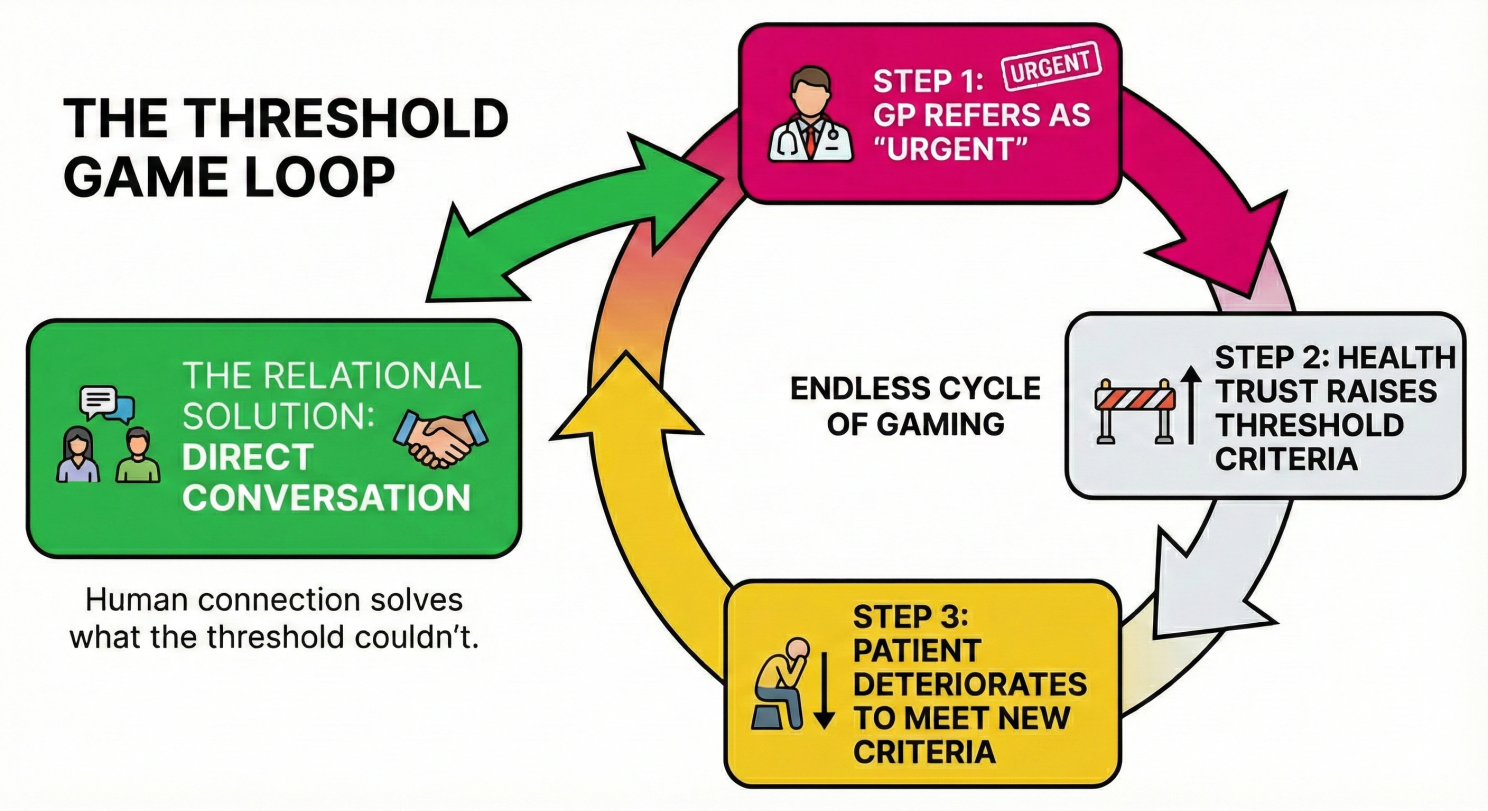
The rationing of care: Because the system processes units of work, it must limit volume. Enter "thresholds." But thresholds aren't just a design feature. They're also a symptom of failure. The Service Factory is overburdened, under-resourced, and ineffective. It can't manage demand, so it rations access rather than addressing the underlying problems that generate the demand in the first place. Services turn people away unless they're severe enough. The perverse incentive? Let your life deteriorate until you're "sick enough" to qualify. Or professionals play what Prof David Thorpe calls "threshold games," knowing the criteria to get the person they're helping escalated for support.
At a community mental health trust we worked with, almost all referrals from GPs claimed to be "urgent." The trust kept changing the criteria, and GPs kept adapting - an endless cycle of gaming. It only stopped when we organised direct conversations between GPs and mental health professionals, talking through their worries and gaining advice. Many GPs were then able to "hold" the person themselves rather than escalating to a long waiting list. The conversation solved what the threshold couldn't.
Threshold games
The erosion of professional autonomy: In the Service Factory, the public-facing worker administers rules, fills forms, meets targets. No space for judgment. No space for empathy. "Computer says no." We use "public-facing" here instead of the more common "frontline". As Toby Lowe and others point out, frontline implies we're at war with our citizens. And yet the term persists. There's a darker truth: some services really are designed as if citizens are the enemy to be processed and moved on. The military language fits because the mindset fits. Perhaps that's precisely why we should change it.
The 15-Minute Care Visit
The most damaging application of Service Factory thinking can be found in the "industrialisation of care."
In the UK but also in other countries, commissioners treat care as a commodity, segmented and purchased in minute units. This gave us the infamous 15-minute home care visit. A care worker enters a home, performs a specific physical task (wash, dress, administer medication), and leaves immediately.
"Time and Task" commissioning. The ultimate triumph of industrial logic over human logic.
The care is defined by a task list, not by changing needs. Every minute is accounted for. "Unproductive" time such as chatting, listening, comforting, is eliminated. Care is stripped of its emotional and relational content and reduced to physical output.
This dehumanises everyone. The recipient is processed, not cared for. The worker becomes a "pair of hands" operating against a stopwatch, their work stripped of all meaning.
Helen Sanderson, drawing on the Buurtzorg model from Holland, proved with her wellbeing teams that the opposite works better. Self-managing teams. Relationships over tasks. Better outcomes, lower costs. But commissioners remained stuck with "Time and Task". They felt they needed that control, even when it was visibly failing.
The digital acceleration
Then came the Government Digital Service.
GDS emerged in 2011 from the wreckage of failed government IT projects, the multi-billion-pound disasters that were specification-heavy, vendor-led, and user-hostile. The founding philosophy was a rejection of "Big IT" in favour of delivery, iteration, and relentless focus on the end user.
And for transactional services, it worked brilliantly.
"Start with user needs." "Do the hard work to make it simple." These principles transformed the administrative interface of the state. Tax renewals, permit applications, voter registration; the labyrinthine bureaucracy became streamlined, accessible digital products. The UK government saved billions. Citizens engaging in routine compliance tasks saw genuine improvements.
But here's what happened next: the success of transactional digital services inadvertently solidified the Service Factory mindset across the entire public sector.
It created a dominant logic where "good service design" became equated with digitising linear processes. Policymakers began viewing all interactions through the lens of digital efficiency. This led to a dangerous category error: the assumption that complex human services such as child protection, homelessness support, family breakdown, could be "redesigned" using the same tools and logic as a driving licence renewal.
GDS optimised the factory. It made the conveyor belt smoother, the interface cleaner, the transactions faster. For simple, high-volume interactions, this was genuine progress.
But it also inadvertently funnelled complex needs into transactional corridors, stripping away the relational nuance required for effective help. The very success of "Digital by Default" made it harder to argue for anything else.
When good Service Design principles go wrong
This is worth dwelling on. Many service design principles that work beautifully for transactions actively harm relational services:
"Start with user needs": When we design around "user needs," we inevitably define citizens by their deficits. We ask: "What does this person lack?" (housing, money, sobriety). The service is then designed to fill that specific hole. This creates a fragmented system where a person with multiple needs, a homeless single mother with debt, say, is dissected into separate "service user" profiles: a housing case, a benefits case, a debt case. Three queues. Three assessments. No one seeing the whole person.
"Make it seamless": In transactional services, hiding complexity from the user is a kindness. But in relational work, people often need to understand the system, their rights, and their options. A family navigating child protection needs to see the seams; the decision points, the criteria, the appeals process. Seamlessness can become a black box that disempowers.
"Reduce friction": For a passport renewal, friction is pure waste. But in a conversation about a family's struggles, "friction" might be the moment of pause where trust forms. The "inefficient" chat. The follow-up question that wasn't on the form. Optimising this away optimises away the very thing that makes help possible; the relationship.
"Be consistent": Consistency builds trust in transactions, e.g. the button is always green, the process always the same. But consistency of process creates inconsistency of outcome in complex lives. If I treat a terrified teenager and a confident adult with the exact same "consistent" interview process, I fail at least one of them. Relational work demands responsiveness and changing the approach to fit the person. If someone is in crisis, they need a responsive human reaction, not a consistent script.
"Design the journey": Journey maps assume a linear progression from A to B. For someone cycling through homelessness, addiction, and mental health crisis, there is no linear journey. Mapping it as such leads designers to optimise a path that doesn't exist.
"Scale the solution": Once you've designed a good transactional service, you should scale it everywhere. But relational approaches depend on local context, trust networks, and relationships that can't be replicated by copying a service specification. What worked in Wigan won't simply transfer to Gateshead. Even with the relational groundwork, it probably won't work the same way, precisely because the context is different. You can share principles. You can't copy and paste relationships.
These principles aren't wrong. They're wrong for relational challenges. The danger is applying them universally.
The fallacy of "Delivery"
Here's the deeper problem: the concept of "delivering" a service implies a unidirectional transfer of value. The state produces; the citizen consumes. This works for a passport. It does not work for "health" or "safety" or "wellbeing."
Outcomes cannot be delivered. You cannot "deliver" a reduction in loneliness. You cannot "deliver" diabetes management. These outcomes are co-produced by the citizen, their community, and the helper working together. As Toby Lowe and colleagues put it in Human Learning Systems: Public Service for the Real World, outcomes are "emergent properties of people's lives as systems." They aren't produced by organisations. They result from the complex web of relationships, factors, and interactions that make up each person's life.
Purpose cannot be delivered either. The delivery mindset assumes we already know what the engagement is for. But in relational work, the purpose itself has to be discovered together. What matters to this person? What are we actually trying to achieve here? These questions can only be answered through relationship, not in advance of it.
And you cannot deliver a relationship. Relationships are reciprocal. They require both parties to shape the process, not just the outcome. When we focus only on delivering outcomes, we skip the work of understanding what the engagement is actually about. We miss the purpose. We miss the process. We miss the relationship itself.
Falling for the transactional trap. By framing these interactions as services to be delivered, we measure the wrong things. We measure volume of transactions (number of assessments, number of visits) rather than quality of relationship, change in life trajectory, or what matters to the citizen. We count what the factory produces, not what actually matters. This is why the Service Factory fails. It assumes outcomes can be manufactured and delivered like products. But you can't manufacture trust. You can't deliver wellbeing on a conveyor belt.
For a deeper exploration of these ideas and a comprehensive alternative to the Service Factory model, see Human Learning Systems: Public Service for the Real World (Lowe et al., 2021), particularly the "Human" chapter, which sets out what it means to see citizens as whole people within the context of their relationships and lives.
The result? A two-tier state. For the healthy, wealthy, and digitally literate, government is a slick, invisible app. For the vulnerable, complex, and excluded, it remains a rigid, less safe, dehumanising factory…but now with better UX (User Experience).
Why did we write this book?
The Service Factory works for what it was designed for: high-volume, low-complexity transactions. Passports. Vehicle tax. A clear beginning, middle, and end. Binary success.
But the Service Factory is fundamentally ill-equipped for "wicked problems" such as chronic health conditions, family breakdown, homelessness, entrenched inequality. Problems where the relationship is the intervention.
We didn't just inherit this system. We built it. Layer by layer; management theory, then NPM, then digital transformation. Each wave making the factory logic harder to refute.
Here's why this matters: the costs and the suffering are in the complexity.
The process of how to design transactional services is largely solved. We know how to do passports well. The unsolved problems, namely the ones consuming budgets, burning out staff, and failing citizens are the relational ones. Families in crisis. People cycling through homelessness. Children on the edge of care. Elderly people isolated and deteriorating. People with disabilities forgotten.
This is where the money goes. This is where the trauma accumulates. And this is where the Service Factory keeps failing, no matter how it’s optimised
The purpose of this book is simple: to help people change how public services are designed and developed. We want to change the change.
We need to stop applying factory logic to human complexity.
We need designers, commissioners, and practitioners who can recognise when they're dealing with relational challenges, who have the tools to respond differently and have the curiosity to care.
We need Relational Service Design.
The next chapter explores what's been missing: the dimension of complexity we've consistently failed to see.
(c) Basis Ltd, 2026 Dennis Vergne & Joe Badman
References
Baehr, P. (2001) 'The "Iron Cage" and the "Shell as Hard as Steel": Parsons, Weber, and the Stahlhartes Gehäuse metaphor in The Protestant Ethic and the Spirit of Capitalism.' History and Theory, 40(2), pp. 153–169.
Banta, M. (1993) Taylored Lives: Narrative Productions in the Age of Taylor, Veblen, and Ford. Chicago, IL: University of Chicago Press.
Chase, R.B. (1978) 'Where Does the Customer Fit in a Service Operation?' Harvard Business Review, 56(6) (Nov–Dec), pp. 137–142.
Chase, R.B. (1981) 'The Customer Contact Approach to Services: Theoretical Bases and Practical Extensions.' Operations Research, 29(4), pp. 698–706. https://doi.org/10.1287/opre.29.4.698
de Blok, J. (2011) Buurtzorg: A New Perspective on Elder Care in the Netherlands. Available at: https://www.buurtzorg.com
Dunleavy, P., Margetts, H., Bastow, S. and Tinkler, J. (2006) Digital Era Governance: IT Corporations, the State, and e-Government. Oxford: Oxford University Press.
Garvin, D.A. and Chase, R.B. (1989) 'The Service Factory.' Harvard Business Review, 67(4) (Jul–Aug).
Government Digital Service (2012) Government Digital Strategy. London: Cabinet Office. Available at: https://www.gov.uk/government/publications/government-digital-strategy
HM Revenue & Customs (2011) Exploring models of front and back office integration: Final report. London: HMRC.
Hood, C. (1991) 'A Public Management for All Seasons?' Public Administration, 69(1), pp. 3–19. https://doi.org/10.1111/j.1467-9299.1991.tb00779.x
Levitt, T. (1972) 'Production-Line Approach to Service.' Harvard Business Review, 50(5), pp. 41–52.
Levitt, T. (1976) 'The Industrialization of Service.' Harvard Business Review, 54(5), pp. 63–74.
Lowe, T. et al. (2021) Human Learning Systems: Public Service for the Real World. London: Centre for Public Impact. Available at: https://www.centreforpublicimpact.org/assets/documents/hls-real-world.pdf
Sanderson, H. (2020) Wellbeing Teams: A Guide to Creating Wellbeing Teams. Stockport: Wellbeing Teams.
Schmenner, R.W. (1986) 'How can service businesses survive and prosper?' Sloan Management Review, 27(3), pp. 21–32.
Seddon, J. and O'Donovan, B. (2010) 'Efficiencies in public service delivery.' In: Richardson, J. (ed.) From Recession to Renewal: The Impact of the Financial Crisis on Public Services and Local Government. Bristol: Bristol University Press/Policy Press, pp. 135–156.
Smith, A. (1776) An Inquiry into the Nature and Causes of the Wealth of Nations. London: W. Strahan and T. Cadell.
Taylor, F.W. (1911) The Principles of Scientific Management. New York: Harper & Brothers.
Thorpe, D. (2007) 'Rethinking Child Protection.' In: Thorpe, D. and Bilson, A. (eds.) From Protection to Transformation: Reframing Children's Services. London: Russell House Publishing.
Weber, M. (1930 [1905]) The Protestant Ethic and the Spirit of Capitalism. Trans. T. Parsons. London: Allen & Unwin.
Weber, M. (1978 [1922]) Economy and Society: An Outline of Interpretive Sociology. Eds. G. Roth and C. Wittich. Berkeley, CA: University of California Press.